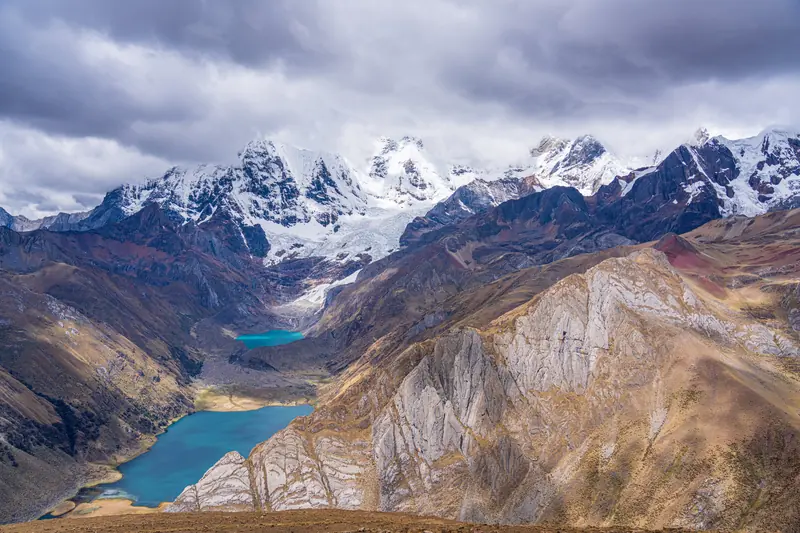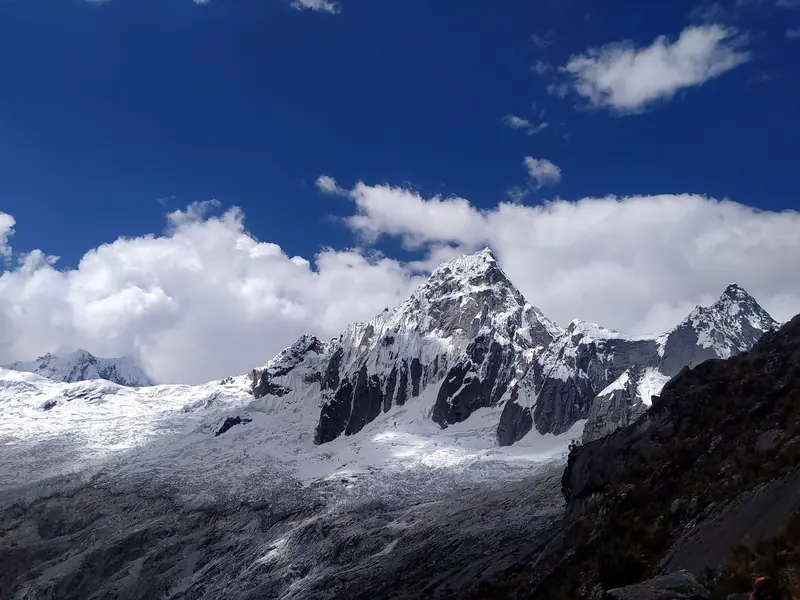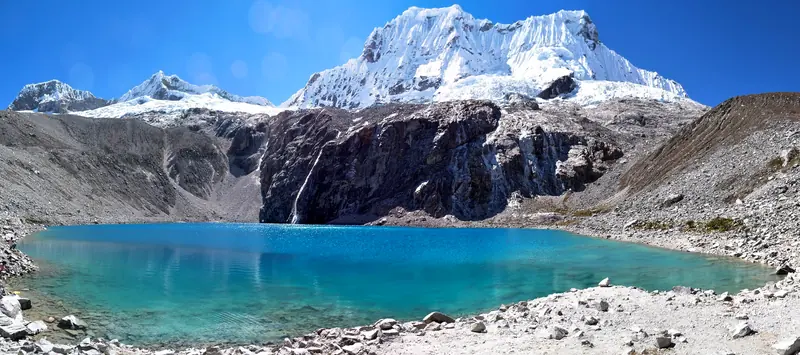
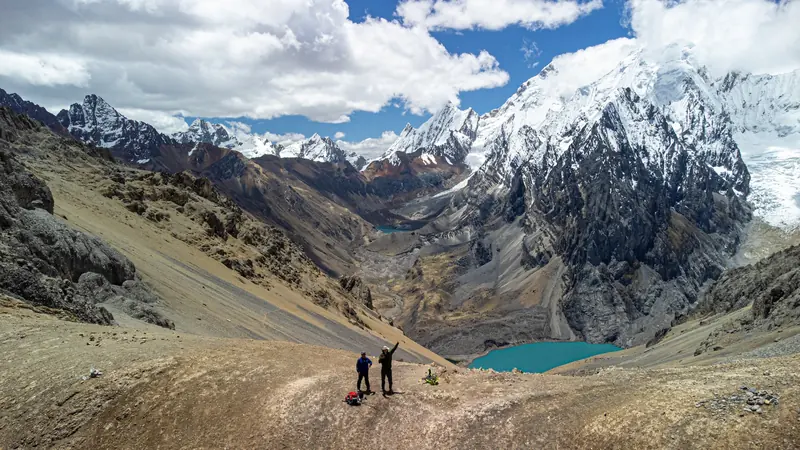
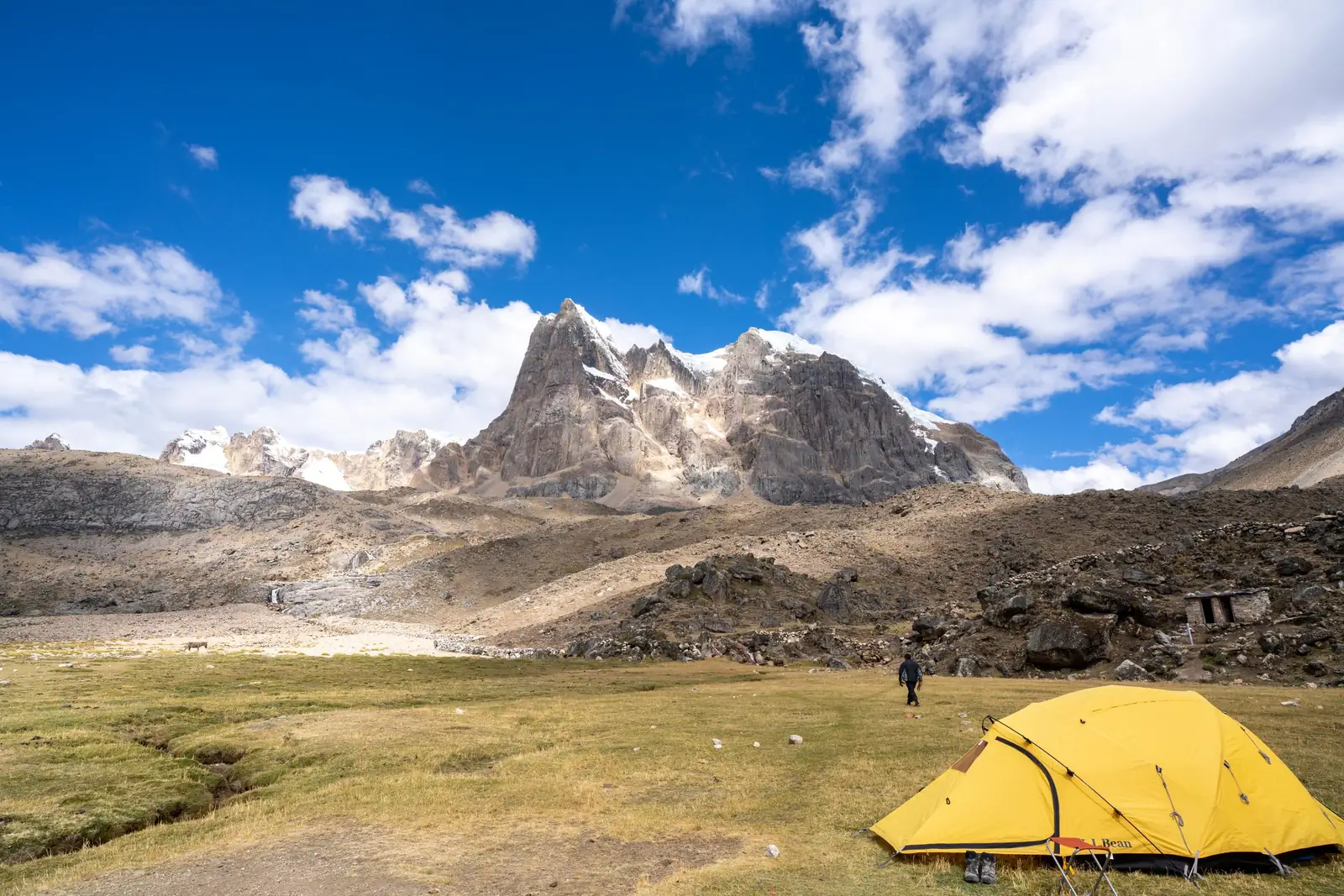


The 8-day Huayhuash trek is a shorter version of the Cordillera Huayhuash circuit: instead of looping around via Laguna Viconga and Cuyoc pass, it takes a shortcut over Trapecio pass, 4,750 m (15,580 ft). It passes Laguna Carhuacocha, Siula pass (4,800 m / 15,750 ft), the high point of the route, and Laguna Jahuacocha, with one rest day and an optional climb of Diablo Mudo (5,223 m) on day 7. The days are long, so it is very demanding. Huayhuash is a reserved zone, not a national park, and each community along the route charges a fee at its campsites.
- Duration
- 8 days (7 nights camping)
- Max. altitude
- 4,800 m
- Difficulty
- Very challenging
- Departs from
- Huaraz, 7:00 a.m. (private bus)
- Price
- Ask for price
Reserved zone and community fees on the 8-day Huayhuash trek
The Cordillera Huayhuash is not part of Huascarán National Park: it is the Cordillera Huayhuash Reserved Zone, created in December 2002 (Ministerial Resolution 1173-2002-AG). That is why the SERNANP ticket used in the Cordillera Blanca does not apply.
Instead, each campesino community along the route charges its own fee at its campsites, and the amounts change from season to season: we give you the updated total when you book. You stay on the shared trails, camp where each community indicates and pack out all your trash.
Highlights
- Lakes Carhuacocha and Jahuacocha and Siula pass (4,800 m), facing Yerupajá, in just 8 days.
- A shortcut over Trapecio pass (4,750 m), with views of the snow peaks of the Huayhuash and Raura ranges.
- A rest day at Guanacpatay and an optional climb of Diablo Mudo (5,223 m) on day 7.
- Arrieros (muleteers) and their pack animals carry the camp, so you hike with a light daypack.
Itinerary
- Day 1Huaraz – Chiquián – Matacancha
We leave at 7:00 a.m. by bus, heading south via Conococha to Chiquián and the village of Llamac: 4 to 5 hours on the road, with the first views of the Cordillera Huayhuash peaks. We camp at Matacancha (4,250 m), with views of Ninashanca and Rondoy.
- Day 2Matacancha – Cacanan (4,750 m) and Carhuac (4,620 m) passes – Carhuacocha
We climb to Cacanan pass (4,750 m), with views of Jirishanca and the Huallanca range, and descend to about 4,200 m. Then we head south, climb to Carhuac pass (4,620 m) and descend to Laguna Carhuacocha (camp at 4,138 m), facing the east side of Siula, Carnicero and Yerupajá. A 7 to 8-hour day.
- Day 3Carhuacocha – Siula pass (4,800 m) – Huayhuash
We climb to Siula pass (4,800 m), with views of the range's main peaks (Yerupajá, Jirishanca, Siula and Trapecio) and several glacial lakes. Camp at Huayhuash (4,350 m).
- Day 4Huayhuash – Trapecio pass (4,750 m) – Guanacpatay
From Trapecio pass (4,750 m) you see the snow peaks of the Huayhuash and Raura ranges. We descend into the Guanacpatay valley to the San Antonio campsite (4,400 m).
- Day 5Guanacpatay: rest day
A rest day at the San Antonio campsite, at 4,400 m.
- Day 6Guanacpatay – Huayllapa – Huatiac
We follow the valley down to the Huayllapa River, cross it and pass the village of Huayllapa. From there we climb again to the Huatiac campsite (4,300 m).
- Day 7Huatiac – Diablo Mudo (5,223 m, optional) – Laguna Jahuacocha
We set off at 3:00 a.m.: 3 to 4 hours to the moraine and, for those who go for it, the climb to the summit of Diablo Mudo (5,223 m), with views of the range's high glaciers. Afterward we descend through the Huacrish valley to Laguna Jahuacocha, facing Jirishanca and Rondoy. It is a 10 to 11-hour day. The summit is optional.
- Day 8Jahuacocha – Mancapunco pass (4,650 m) – Pocpa – Huaraz
We head out through the Pacllón valley, climb to Mancapunco pass (4,650 m) and descend to the village of Pocpa, where the bus is waiting to take us back to Huaraz.
Times from our agency program; group pace, weather and trail conditions on the passes can change them. Pass and campsite altitudes from our itinerary.
What's included and not included
What's included
- Bus transport Huaraz – Matacancha and Pocpa – Huaraz
- Guide for the whole trek
- Cook
- Arrieros (muleteers) and pack animals
- Camping equipment
Not included
- Community fees on the trail: each community charges at its campsites (we give you the total when you book)
- Travel insurance: we recommend a policy that covers mountain rescue and evacuation
What to bring
- Sleeping bag rated below freezing
- Broken-in hiking boots with good grip
- Layers: thermal base layer, fleece and a down jacket
- Waterproof jacket and pants
- Warm hat, gloves, neck gaiter and sunglasses
- Sunscreen and lip balm
- Headlamp with spare batteries
- Water bottles and purification tablets or a filter
- Trekking poles
- Daypack of 25 to 35 liters
- Passport and cash in Peruvian soles for expenses on the trail
- Your personal medication (acetazolamide only with a prescription, as Peru's Ministry of Health advises)

More information
The route: Huayhuash in 8 days via Trapecio pass
On day 1 we drive via Conococha and Chiquián to Matacancha (4,250 m), at the northern end of the range. Day 2 packs into one day what takes two on the full circuit: we cross the Cacanan (4,750 m) and Carhuac (4,620 m) passes in 7 to 8 hours and reach Laguna Carhuacocha. On day 3 we climb to Siula pass (4,800 m), facing Yerupajá, Siula and Trapecio.
On day 4 we cross Trapecio pass (4,750 m) and descend into the Guanacpatay valley to the San Antonio campsite (4,400 m), where we rest on day 5. Then we descend to Huayllapa and climb to Huatiac; on day 7 we set off at 3:00 a.m. toward Diablo Mudo and Laguna Jahuacocha, and on day 8 we cross Mancapunco (4,650 m) to Pocpa, where the bus picks us up.
| Day | Pass | Campsite |
|---|---|---|
| 1 | — (arrival by bus) | Matacancha, 4,250 m |
| 2 | Cacanan, 4,750 m · Carhuac, 4,620 m | Laguna Carhuacocha, 4,138 m |
| 3 | Siula, 4,800 m | Huayhuash, 4,350 m |
| 4 | Trapecio, 4,750 m | Guanacpatay (San Antonio), 4,400 m |
| 5 | Rest day | Guanacpatay (San Antonio), 4,400 m |
| 6 | — (down to Huayllapa and back up) | Huatiac, 4,300 m |
| 7 | Diablo Mudo, 5,223 m (optional summit) | Laguna Jahuacocha |
| 8 | Mancapunco, 4,650 m | — (bus back to Huaraz) |
Pass and campsite altitudes: our agency itinerary. Yerupajá (6,617 m) and Siula Grande (6,344 m): IGM maps as listed by Wikipedia.
8 or 12 days? How it compares with the full circuit
Both versions start at the northern end of the range, pass Carhuacocha and Siula pass, and finish at Jahuacocha and Pocpa. What changes is the middle section and the pace:
| Fact | 8 days (Trapecio pass) | 12 days (full circuit) |
|---|---|---|
| Highest pass | Siula, 4,800 m | Cuyoc, 5,000 m |
| Passes on the itinerary | Cacanan, Carhuac, Siula, Trapecio and Mancapunco | Cacanan, Carhuac, Siula, Portachuelo, Cuyoc, Tapush and Mancapunco |
| Laguna Viconga | no | yes |
| Rest days | 1 (Guanacpatay) | 2 (Guanacpatay and Jahuacocha) |
| Diablo Mudo (5,223 m, optional) | day 7 | day 10 |
| Pace | long days: two passes on day 2 (7 to 8 h) and 10 to 11 h on day 7 | more days to acclimatize and rest |
Choose 8 days if you are short on time and already hike well at altitude. Choose the 12-day Huayhuash circuit if you want the full loop, with Viconga and Cuyoc pass, and more days to acclimatize.
How hard is it? Fitness, acclimatization and season
It is a very demanding trek: in 8 days you cross five passes between 4,620 and 4,800 m, with two very long days (day 2, and day 7, which starts at 3:00 a.m.) and cold nights in a tent. It involves no technical climbing; for the optional Diablo Mudo summit, we confirm the gear it requires when you book.
The first night is already at 4,250 m (13,940 ft). Arrive in Huaraz (about 3,050 m / 10,000 ft) at least 3 or 4 days before the start and do two day hikes first, such as Laguna Churup and Laguna 69. If you have confusion, shortness of breath at rest or a strong headache that does not ease, the right move is to go down (CDC; Peru's Ministry of Health). The full plan is in our Huaraz acclimatization guide.
The dry season runs from May to September or October, and the rainy season from October to April (SERNANP, for the neighboring Cordillera Blanca). We recommend the dry season: dry passes and more clear days, with very cold nights at the high camps.
Frequently asked questions
8 or 12 days: which Huayhuash trek should I choose?
The 8-day trek takes a shortcut over Trapecio pass (4,750 m): it skips Laguna Viconga and Cuyoc pass (5,000 m), crosses two passes on day 2 and has a single rest day. The 12-day circuit is the full loop, with more days to acclimatize. Choose 8 days if you are short on time and already hike well at altitude.
What is the highest pass on the 8-day Huayhuash trek?
Siula pass, at 4,800 m (15,750 ft), on day 3. The other passes are Cacanan (4,750 m), Trapecio (4,750 m), Mancapunco (4,650 m) and Carhuac (4,620 m). Diablo Mudo (5,223 m) is an optional summit on day 7.
How hard is the 8-day Huayhuash trek?
Very hard: five passes between 4,620 and 4,800 m in 8 days, a 7 to 8-hour day with two passes (day 2) and a 10 to 11-hour day starting at 3:00 a.m. (day 7). You need good fitness, multi-day trekking experience and 3 to 4 days of acclimatization in Huaraz.
How much does the 8-day Huayhuash trek cost?
It depends on group size, dates and what the service includes. Message us on WhatsApp with your dates and we will send you the price and the details. Community fees on the trail are paid separately.
Is there an entrance fee for Huayhuash?
There is no park ticket, because Huayhuash is a reserved zone (Ministerial Resolution 1173-2002-AG), not a national park. Each campesino community along the route charges a fee at its campsites; we give you the updated total when you book.
When is the best time for the 8-day Huayhuash trek?
In the dry season, from May to September or October. From October to April it rains, and the passes can be muddy or snowy.
Is it a good first trek?
Only if you already hike well at altitude: the days are long and nearly the whole route is above 4,000 m. If this is your first multi-day trek, start with the Santa Cruz trek, 4 days with a single high pass.