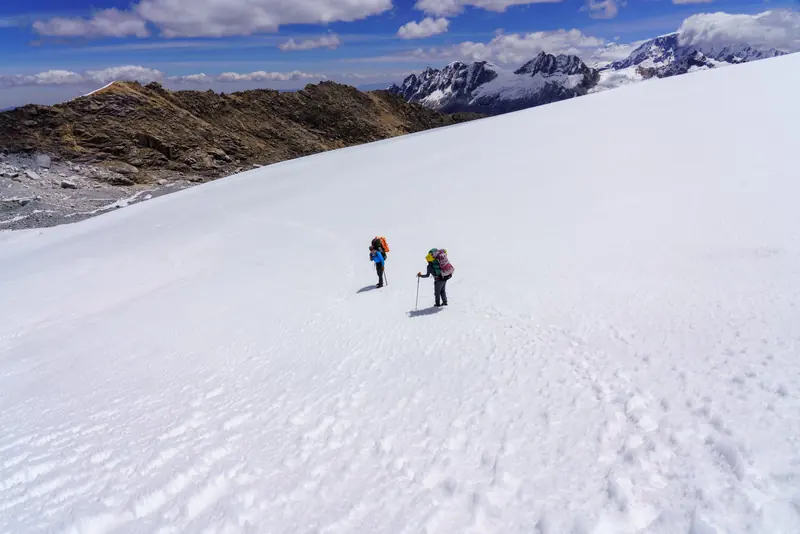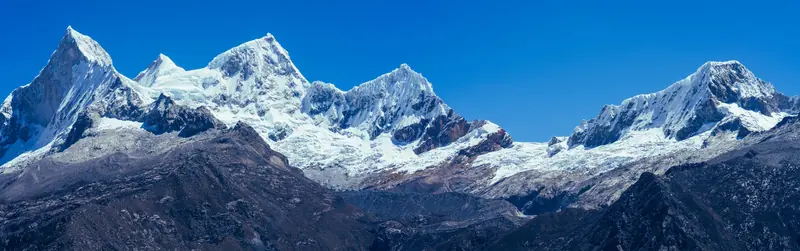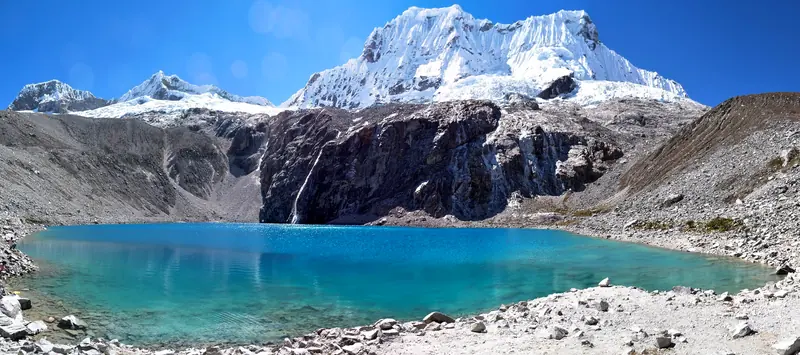
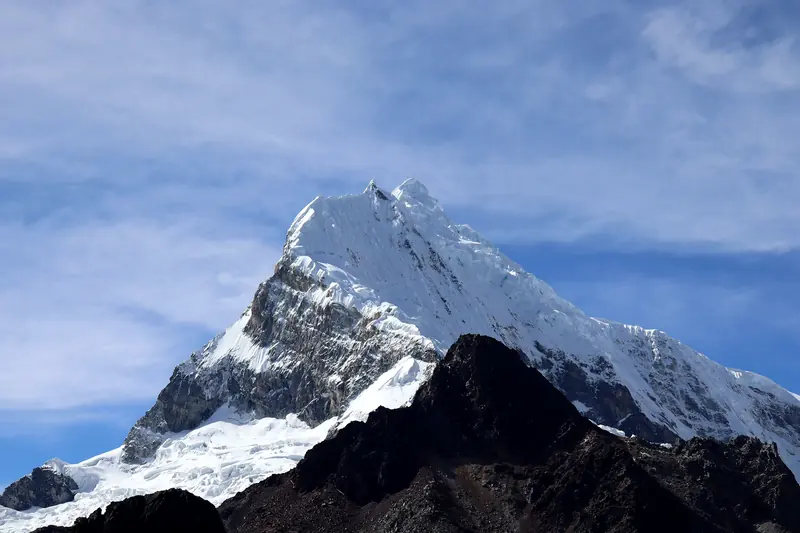
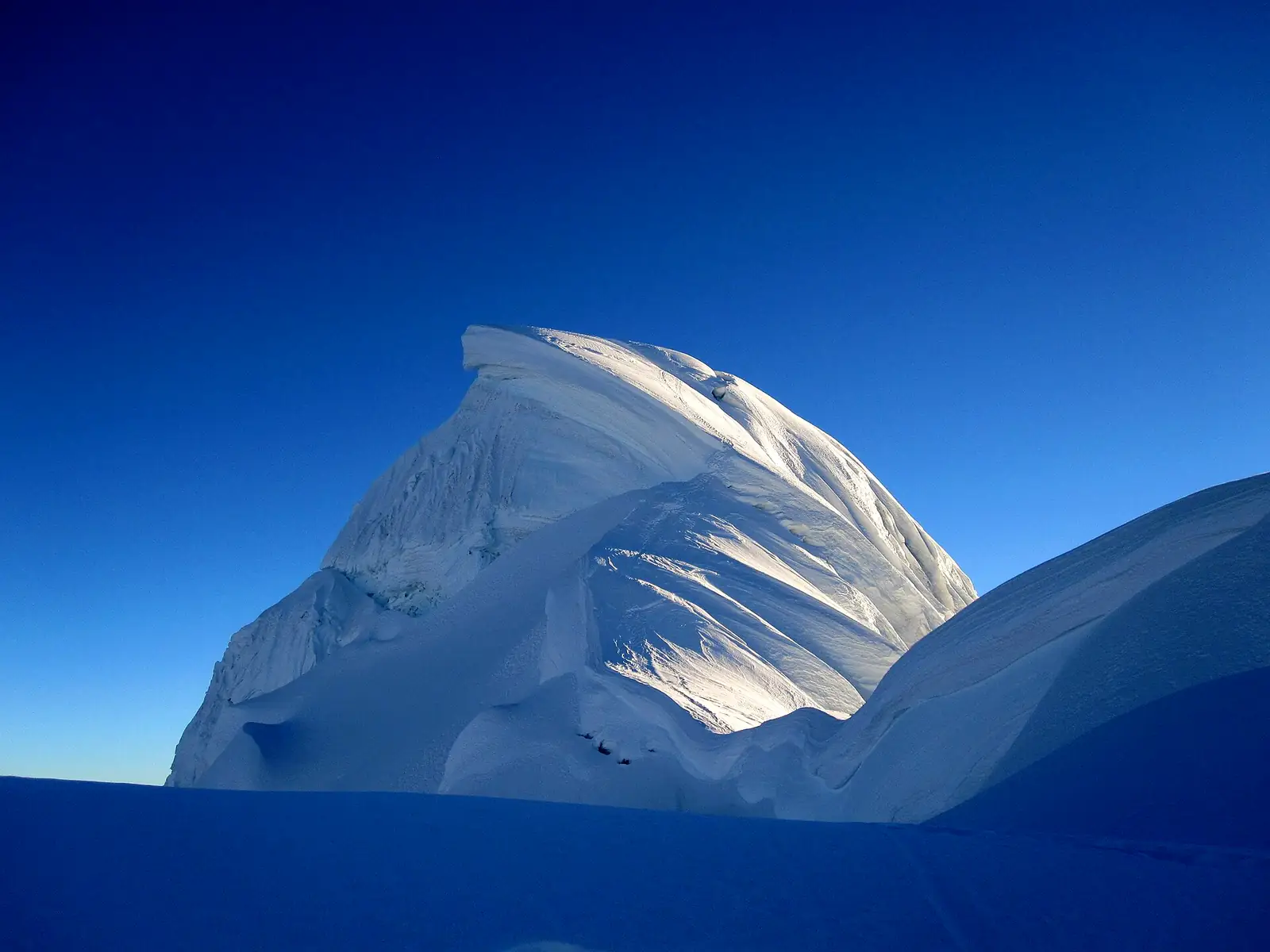


The Chopicalqui expedition is a 5-day, 4-night program from Huaraz to a summit of 6,354 m (20,850 ft) according to SERNANP, in the Llanganuco area of Huascarán National Park. We move up through three camps: base (4,300 m), moraine (4,800 m) and Camp I (5,400-5,600 m). Summit day starts at 3:00 a.m. on the southwest ridge, with 40 to 50° slopes and sometimes deep snow: 7 to 8 hours to the top. It is for climbers with glacier experience.
- Duration
- 5 days / 4 nights
- Max. altitude
- 6,354 m
- Difficulty
- Very challenging
- Departs from
- Huaraz, 8:00 a.m. (private bus)
- Price
- Ask for price
Huascarán National Park rules for Chopicalqui
Chopicalqui is in the Llanganuco area of Huascarán National Park. For a 5-day program you buy the 4 to 30-day park ticket: S/ 150 at the general rate for foreign visitors (SERNANP, 2026).
- Climbing must be done through a tourism service provider and with an official, licensed guide, meaning someone with a mountain guide title from an officially recognized higher-education institution (Jefatural Resolution 196-2006-INRENA, art. 7.1 and 24 b).
- On difficult ascents like this one, a guide may climb with no more than 2 people at a time (art. 25).
- You must register at the control post and carry all your trash out.
Highlights
- A 6,354 m summit (SERNANP), one of the big peaks seen from Llanganuco alongside Huascarán and Huandoy.
- A progressive ascent with three camps: 4,300, 4,800 and 5,400-5,600 m.
- The southwest ridge, with 40 to 50° slopes up to the summit shoulder.
- A step toward 6,000 m peaks if you have already climbed peaks of around 5,500 m, such as Pisco or Ishinca.
Itinerary
- Day 1Huaraz – Llanganuco – base camp
We leave at 8:00 a.m. by private bus, north through the Callejón de Huaylas to Yungay, and up the Llanganuco valley. From the turnout we hike half an hour to base camp, at 4,300 m.
- Day 2Base camp – moraine camp
We start at 8:00 a.m. The trail climbs straight up and stays on the ridge crest all the way to the moraine camp, at 4,800 m: 4 to 5 hours of hiking.
- Day 3Moraine camp – Camp I
We scramble up the rock slabs above camp and continue east on the glacier to Camp I, at 5,400-5,600 m. 4 to 5 hours.
- Day 4Chopicalqui summit
We start at 3:00 a.m. on the southwest ridge, with sometimes deep snow and 40 to 50° slopes up to the summit shoulder. We reach the top (6,354 m) in 7 to 8 hours and descend the same route to the moraine camp, 4 to 5 hours.
- Day 5Moraine camp – base camp – Huaraz
We descend the same route to base camp (2 to 3 hours), walk 30 minutes to the turnout and drive back to Huaraz by private bus.
Schedule from the agency's program. Walking times depend on the group's pace, the weather and glacier conditions; the guide may change the summit start time or turn the group around for safety.
What's included and not included
What's included
- Private bus Huaraz – Llanganuco – Huaraz
- Mountain guide
Not included
- Huascarán National Park ticket for 4 to 30 days (SERNANP, 2026): S/ 150 at the general rate
- Travel insurance: we recommend one that covers mountain rescue and evacuation
What to bring
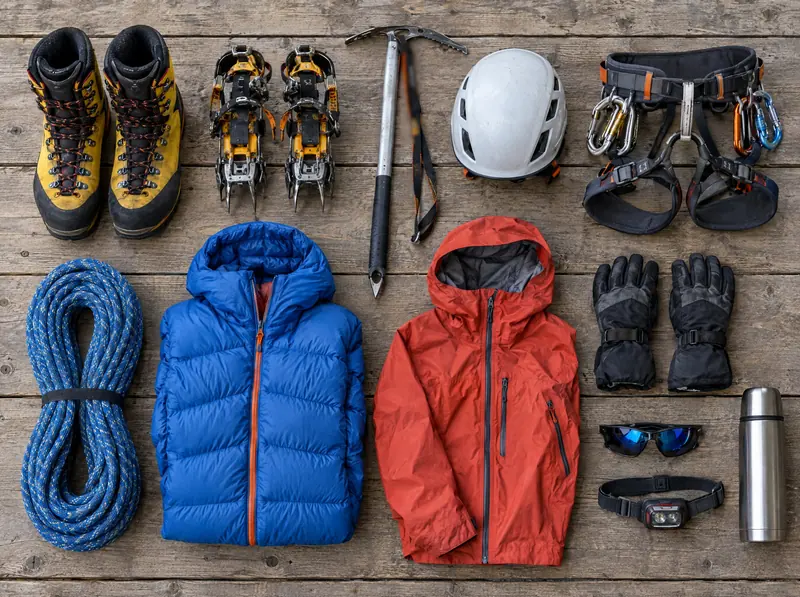
- Crampon-compatible mountaineering boots suitable for 6,000 m peaks
- Crampons, ice axe, harness and helmet (ask which ones the agency provides)
- Sleeping bag rated below freezing, suitable for a high camp above 5,400 m
- Layers: thermal base layer, fleece, down jacket, and waterproof jacket and pants
- Warm hat, thick gloves, buff and glacier sunglasses
- Headlamp with spare batteries: the summit push starts at 3:00 a.m.
- Sunscreen and lip balm
- Bottles or a thermos for 2 liters of water, and food for a summit day of more than 11 hours
- Passport for the control post
More information
The route: southwest ridge
From Camp I, at 5,400-5,600 m, the route follows the southwest ridge. On this side the snow can be deep, with 40 to 50° slopes up to the summit shoulder: 7 to 8 hours up and 4 to 5 hours back down the same way to the moraine camp. It is a long day above 5,400 m, with crampons, an ice axe and a rope.
Below Camp I you scramble up rock slabs above the moraine and continue east on the glacier. The ascent is progressive: you sleep three nights in ever-higher camps (4,300, 4,800 and 5,400-5,600 m) before the summit.
| Day | Section | Altitude | Schedule or time |
|---|---|---|---|
| 1 | Huaraz → Yungay → Llanganuco valley (private bus), then hike to base camp | up to 4,300 m | 8:00 a.m. departure; 30 min on foot |
| 2 | Base camp → moraine camp, along the ridge crest | 4,300 m to 4,800 m | 8:00 a.m. start; 4 to 5 h |
| 3 | Moraine camp → rock slabs → glacier → Camp I | 4,800 m to 5,400-5,600 m | 4 to 5 h |
| 4 | Camp I → summit via the southwest ridge → moraine camp | up to 6,354 m | 3:00 a.m. start; 7 to 8 h up and 4 to 5 h down |
| 5 | Moraine camp → base camp → Huaraz (private bus) | down to about 3,050 m | 2 to 3 h on foot and 30 min to the bus |
Schedules, camp altitudes and route description: the agency's program. Summit altitude: SERNANP.
Requirements: acclimatization, experience and gear
- Acclimatization: give yourself several days in Huaraz and do high-altitude hikes first, such as Laguna Churup or Laguna 69, and ideally a peak of around 5,500 m, such as Pisco. See our Huaraz acclimatization guide.
- Experience: previous experience on glaciers and on 40 to 50° snow and ice slopes with crampons and an ice axe, and time above 5,500 m before.
- Technical gear: crampon-compatible mountaineering boots, crampons, ice axe, harness and helmet, plus warm layers and a sleeping bag rated below freezing: Camp I is above 5,400 m. Which gear the agency provides and what you can rent in Huaraz is confirmed when you book.
- Health: if you have high blood pressure or heart rhythm problems, travel with your medication and a recent medical check-up, and do not take acetazolamide without a prescription (Peru's Ministry of Health).
Best time to climb Chopicalqui
SERNANP recommends visiting the park from May to October, in the dry season. On the southwest ridge the snow can be deep even in those months, and with the October to April rains, fresh snow slows the climb down.
Frequently asked questions
Do I need experience to climb Chopicalqui?
Yes. You need previous experience on glaciers and on 40 to 50° snow and ice slopes, and time above 5,500 m before. A good step beforehand is Pisco or our Ishinca and Tocllaraju program.
How many days should I acclimatize first?
Give yourself several days in Huaraz, do high-altitude hikes such as Laguna Churup and, ideally, a peak of around 5,500 m first. See our acclimatization guide.
What gear do I need?
Crampon-compatible mountaineering boots, crampons, ice axe, harness, helmet, warm layers and a sleeping bag rated below freezing, suitable for a high camp above 5,400 m. When you book we confirm which gear the agency provides and what you can rent in Huaraz.
When is the best time to climb Chopicalqui?
The dry season: SERNANP recommends visiting the park from May to October. From October to April it rains, and it snows up high.
How many climbers per guide?
Huascarán National Park rules say that on difficult ascents a guide may climb with no more than 2 people at a time (Jefatural Resolution 196-2006-INRENA, art. 25). We confirm the ratio for your group when you book.
How high is Chopicalqui?
6,354 m (20,850 ft), according to SERNANP. Peru's military mapping gives 6,345 m. It is in the Llanganuco area, next to Huascarán.